A practical, safety-first walkthrough for new shooters: legal basics, fit-first selection, storage, training, and budgeting.
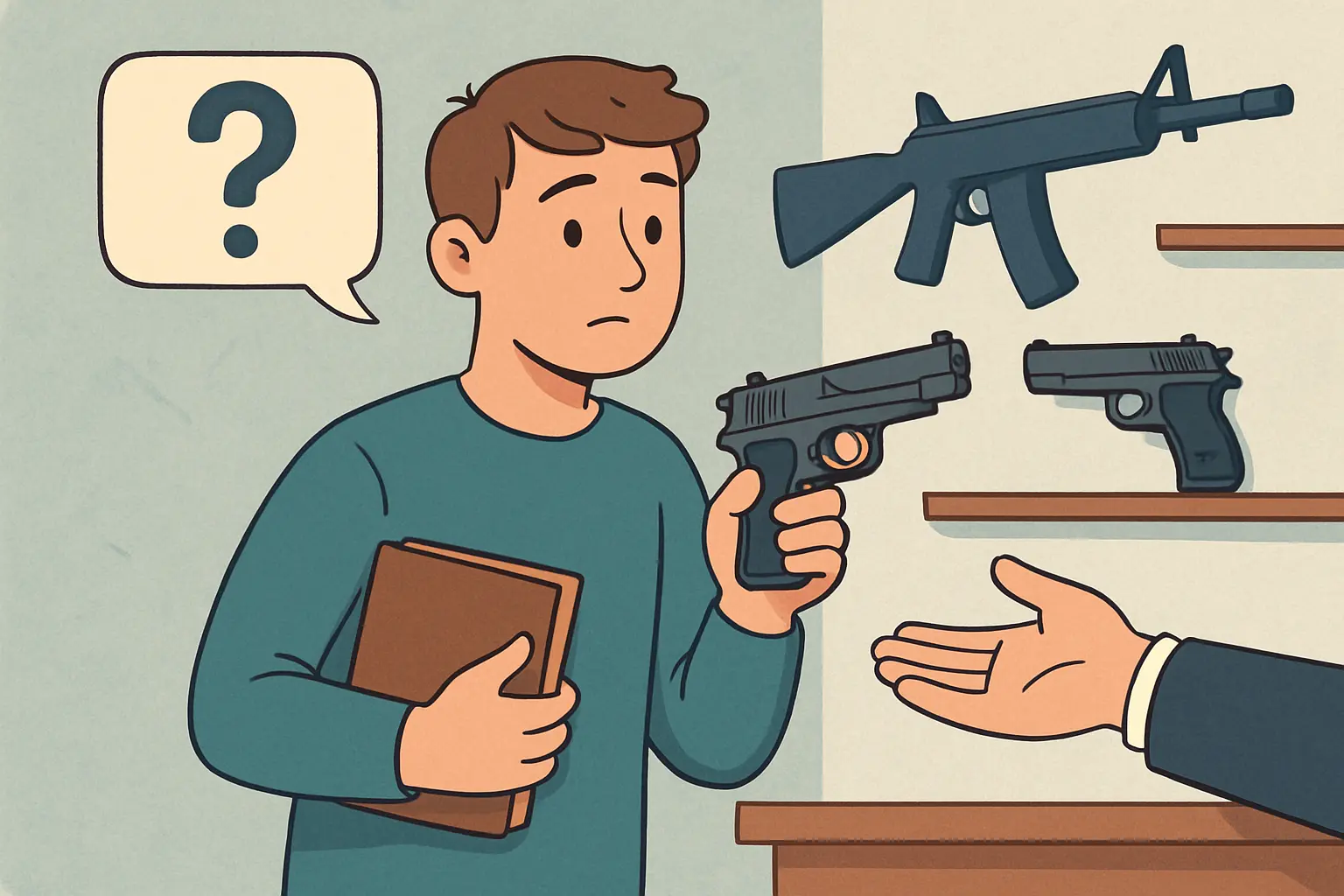
I remember the first time I brought a new shooter to the range. She was an ICU nurse, cool under pressure and meticulous about safety. The gun counter, though, nearly broke her—rows of black polymer and steel, acronyms flying, well-meaning strangers offering conflicting advice. By the end of that day, she’d fired three handguns, learned how to test fit and manage recoil, and understood the legal steps to take before buying her first gun. She also left with a plan: not just which pistol to buy, but where to train, how to store it responsibly, and how much the first year would realistically cost.
This guide exists to give you that same end-to-end clarity. It’s model-agnostic and beginner-first, built from years on both sides of the gun counter, on the firing line with new shooters, and inside classrooms that teach safe, lawful, confident ownership. You’ll get safety-forward, law-compliant steps; plain-English explanations of the gun buying process (FFL, NICS, permits, waiting periods); a fit-first methodology; training and storage plans; and practical picks grounded in use-cases like home defense, concealed carry, range practice, or hunting.
At a glance: How to buy your first gun
- Confirm legal eligibility and minimum age under federal and state law
- Choose your primary use-case: home defense, concealed carry, range, or hunting
- Try rental guns or attend demo days to test fit, trigger reach, and recoil
- Pick a reputable local FFL (licensed dealer) and learn your state’s requirements
- Complete any required training, permits, or purchase cards before shopping
- Pass the background check and comply with any waiting period
- Buy safe storage and basic protective gear the same day you buy the firearm
- Book training; build a practice routine you’ll actually follow
What you need to buy a gun for the first time
When people ask what they need to bring to the store, they expect a long list. In reality, the core is simple—what varies is your state’s specific add-ons.
- Government-issued photo ID with current address (driver’s license or state ID). If your address is outdated, bring official proof of residence as required by your state or dealer.
- Legal eligibility: You must be legally able to own a firearm under federal and state law. Dealers will have you certify this on ATF Form 4473.
- Background check: A NICS check through the FBI or a state background check system. Some states require additional purchase permits or firearm owner ID cards.
- Waiting period: If your state has one, plan accordingly; the dealer will release the gun only after the period expires.
- Payment method: Expect to pay the gun price, plus taxes and any state fees, plus an FFL transfer fee if buying online.
If you’re buying from a private party, many states require the transfer to go through an FFL; others have their own private-sale rules. When in doubt, route the sale through an FFL to ensure compliance.
Decide your primary use-case before you shop
Skipping this step leads to buyer’s remorse—decide whether your primary need is home defense, concealed carry, range practice, or hunting. Use-case drives caliber, barrel length, and accessories.
Home defense
Prioritize simplicity, controllability, and reliable access. Compact or full-size 9mm pistols, pistol-caliber carbines (PCCs), or 20-gauge shotguns are common starting points. Plan for a quick-access safe and a white light for target identification.
Concealed carry
Focus on size, weight, capacity, and shootability. Micro-compact and compact 9mm pistols dominate. Expect to need a permit in many states, a quality holster that fully covers the trigger guard, and a carry belt.
Range/recreational
Seek low recoil and affordable ammo; .22 LR pistols and rifles shine here, letting you learn fundamentals cheaply and comfortably.
Hunting
Start with a clear game plan. For small game, a .22 LR rifle; for upland birds or clay targets, consider a 20-gauge shotgun; for larger game, a centerfire rifle appropriate to the quarry and your state’s laws.
Fit and ergonomics: how to choose the right gun size and grip
If you learn only one expert trick from this guide, let it be this: fit comes before brand. The best first handgun for beginners is the one that fits your hands, your strength, and your intended use. Evaluate three things in this order.
1) Grip circumference and trigger reach
- Get a neutral firing grip. The web of your hand should sit high on the backstrap. Wrap your fingers around the grip with your trigger finger straight alongside the frame.
- Check trigger reach. Place the middle of your trigger finger pad on the trigger shoe without straining. If you must overextend, the grip is too long; if your knuckle lands on the trigger, it’s too short.
- Backstraps and grip modules matter. Many pistols include interchangeable backstraps.
Simple fit guide (hand length measured from wrist crease to fingertip)
- Under 6.5 inches: prioritize slim grips, small backstraps, or micro-compact frames.
- 6.5 to 7.5 inches: most compact and full-size 9mm pistols fit with the correct backstrap.
- Over 7.5 inches: medium/large backstraps often give better control.
2) Controls and slide operation
- Can you rack the slide smoothly without pain? If not, consider lighter-recoil options, hammer-fired guns that can be cocked, or a revolver.
- Are magazine release and slide stop reachable without breaking your firing grip? Left-handed shooters should look for ambidextrous or reversible controls.
3) Recoil management and weight
A little more weight is your friend—compact and full-size guns usually shoot softer than micro-compacts in the same caliber.
How to test-fit at a store or rental range
- Dry grip drill: establish a firing grip and run smooth trigger presses with snap caps if allowed.
- Draw and safety sweep: with unloaded or dummy guns under supervision, practice draws and control manipulation.
- Live-fire rental: put 10–20 rounds through contenders at 5–7 yards and judge recoil control and sight recovery.
Caliber basics for beginners
The best caliber depends on purpose and recoil tolerance. Keep decisions simple:
- 9mm Luger: Standard for defensive handguns—manageable recoil, abundant training ammo, effective defensive loads.
- .22 LR: Ideal for learning fundamentals with negligible recoil and very low cost.
- .380 ACP: Lower recoil than 9mm in similar-size guns; can be snappy in very small pistols.
- .38 Special (revolvers): Mild to moderate recoil in steel-frame revolvers; good for training and defense.
- 20 gauge vs 12 gauge: 20 gauge offers lower recoil for many new shooters while still effective for home defense.
- PCCs and .223/5.56 rifles: Low recoil and good ergonomics, with attention to over-penetration and local laws.
Popular comparisons for first-time buyers
- 9mm vs .380: 9mm is more versatile; .380 can be easier in larger guns but may be snappy in micro frames.
- Revolver vs semi-auto: Revolvers offer simplicity; semi-autos offer capacity and easier triggers but require learning the manual of arms.
- 12 gauge vs 20 gauge: 20 gauge is friendlier to recoil-sensitive shooters.
- Striker-fired vs hammer-fired: Striker-fired guns have consistent triggers and fewer external controls; hammer-fired offer second-strike options and can be cocked first.
- Micro-compact vs compact: Micro-compacts carry easier but are harder to shoot well; compacts are more forgiving.
Revolver vs semi-auto vs shotgun vs rifle: pros and cons
Handgun (semi-auto)
- Pros: Higher capacity, lighter triggers, accessory rails.
- Cons: Requires learning magazine management and malfunction clearing.
Revolver
- Pros: Mechanical simplicity and tolerance for neglect.
- Cons: Heavy double-action trigger, slower reloads, lower capacity.
Shotgun
- Pros: Significant stopping power and intuitive manual of arms.
- Cons: Recoil and length matter; pattern and penetration must be understood.
Rifle / PCC
- Pros: Easiest to hit under stress; low recoil in PCCs and many .223 carbines.
- Cons: Storage and maneuverability in tight spaces; local laws can vary.
The legal process: federal basics and state layers
At the counter you’ll complete ATF Form 4473 and undergo a background check (NICS or state system). Dealers won’t transfer until the check returns proceed or state rules are satisfied.
Key legal concepts to know
- FFL dealer: Federally licensed dealer who runs your background check and completes transfers.
- NICS background check: Federal check to ensure legal eligibility.
- Waiting period: Delay between purchase and pickup in some states.
- Purchase permits / FOID / FID / LTC: Some states require specific cards or permits.
- Concealed carry license: Separate from purchase; usually requires training and a separate application.
- Private party transfer rules: Vary—many states require FFL involvement.
You’re responsible for following both federal and state law. Laws change—check your state police/attorney general pages and the ATF for current rules.
Buying online vs local store: how FFL transfers work
You can buy a gun online, but it ships to an FFL, not your home. The dealer receives the firearm, you complete Form 4473, pass the background check, and pay any transfer fee.
- Choose an online seller and select a local FFL to receive the firearm.
- Confirm the receiving FFL’s transfer fee and policies before purchase.
- Seller ships to the FFL. You visit the FFL to complete paperwork and pass checks.
- Pay the transfer fee and any state-mandated fees at pickup.
Local stores give hands-on fit testing, post-sale support, and a smoother first-time process. Online shopping offers inventory breadth and price comparison.
Total cost and first-year budget
The surprise isn’t the gun’s sticker price—it’s training, storage, ammo, and accessories. Plan for those up front.
Defensive handgun starter (9mm)
- Handgun: mid-range
- Extra magazines (2)
- Holster and belt
- White light (if rail-equipped)
- Safe/lock box
- Eye/ear protection
- Cleaning kit
- Training course(s)
- Ammo: 500–1000 rds practice, 50–100 rds defensive
Range/recreational (.22 LR)
- Firearm: lower to moderate
- Safe/lock box
- Eye/ear protection
- Cleaning kit
- Intro course or lesson
- Ammo: 1000–2000 rds .22
Save on accessories early; spend on fit and training. Don’t skimp on secure storage.
Safe storage: gun safe vs lock box for apartment
Your first accessory should be secure storage chosen for your living situation.
- Quick-access lock box: Ideal for bedside or apartments; biometric or keypad options.
- Small safe: More room and theft/fire protection; look for fast access and mounting hardware.
- Full-size safe: Best for larger collections and fire protection; consider anchoring and floor load.
- Cable locks: Good as a supplemental layer but too slow for emergency access.
Follow state storage laws, especially if minors are present. Responsible storage is non-negotiable.
Training and safety roadmap: your first 90 days
Shooting skill is perishable—small, consistent steps are the key.
Weeks 1–2: Foundations
- Beginner safety course covering the four rules, loading/unloading, and range etiquette.
- Dry fire 10 minutes, three nights a week (snap caps if appropriate).
Weeks 3–6: Live-fire basics
- Two range trips focusing on grip, sight alignment, and smooth trigger press at 5 yards.
- Drills: slow-fire groups, one-shot-from-ready, and five-shot recoil control strings.
Weeks 7–10: Introduce context
- Take a class for home defense or concealed carry that includes movement, reloads, and malfunction clearing.
- Pattern shotgun loads and verify rifle zero.
Weeks 11–12: Storage and maintenance mastery
- Practice quick-access safe routine and learn a field strip/cleaning cycle.
- Log round counts and any malfunctions.
Range etiquette for first-timers
- Always point the muzzle in a safe direction and obey range commands.
- Ask before touching someone else’s firearm.
- Leave your bench clean and police brass if permitted.
- Notify staff of any unsafe behavior or injury immediately.
Recoil management for beginners
- Grip high and hard with both hands; thumbs forward along the frame.
- Stand slightly aggressive with nose over toes; knees unlocked.
- Press the trigger straight back without clenching the whole hand.
Try before you buy: how to test a gun at the range
- Bring a short list: one or two compact 9mm pistols, a .22 LR trainer, and relevant shotguns or PCCs.
- Fire 10 rounds slow, 10 rounds in pairs, and 5 rounds strong-hand-only to assess ergonomics and recoil.
- Observe if you fight trigger reach or shift grip for controls; note follow-up shot control.
Inclusive fit: small hands, left-handed shooters, and arthritis-friendly options
- Small hands: Look for small backstraps and short trigger reach.
- Left-handed: Seek ambidextrous or reversible controls; practice technique if not available.
- Seniors/arthritis: Favor softer recoiling calibers, lighter springs, or longer-barreled revolvers with tuned triggers.
Beginner ammo guide: FMJ vs JHP and how much to buy
- FMJ: Practice ammo—feeds well and is inexpensive.
- JHP: Defensive ammo—buy a few boxes to function test your gun.
- How much: Start with ~500 rounds FMJ for practice and 50–100 rounds JHP to verify function.
Essential accessories for first-time buyers
- Eye/ear protection (electronic muffs and clear wraparound glasses).
- Quality holster that fully covers the trigger guard; for IWB pair with a sturdy belt.
- Cleaning kit: bore brush, jag, solvent, and light oil.
- White light for home defense on firearms with a rail.
The first range trip: a simple checklist
- Eye/ear protection, ammo, locked case, magazines, targets, tape, small multi-tool, cleaning cloths, and a notebook.
- Know the range’s hot/cold line procedures and ask staff for orientation if unsure.
First-time gun buyer mistakes to avoid
- Buying on hype or looks before testing fit.
- Ignoring storage and training costs.
- Starting too small—micro-compacts often punish new shooters.
- Skipping quality holsters or dry fire practice.
- Rushing to accessories before fundamentals are solid.
- Overlooking local laws on magazines, transport, and storage.
Home defense: building a responsible plan
- The gun is not the plan. Develop routes, communication, and safe-room procedures.
- Use a white light for target ID and choose defensive ammo designed to limit over-penetration.
- Train to identify, decide, and act; realistic classes reduce critical errors under stress.
Concealed carry: best first carry considerations
- Comfort vs control: compacts often shoot better than micro-compacts for beginners.
- Holster fit and ride height often matter more than shaving ounces from the gun.
- Use a purpose-built belt and adjust clothing; practice draws and reholstering unloaded first.
Hunting and field use: first rifle or shotgun for beginners
- .22 LR rifle: Best for fundamentals and small game.
- Shotguns: Fit (length of pull, comb, recoil pad) is critical—start with a 20 gauge for gentler recoil.
How to buy a gun in your state: a standardized mini-guide
Use this framework and verify specifics with your state police/attorney general.
- Eligibility: confirm age and legal status.
- Purchase permission: FOID/FID/LTC or permit to purchase?
- Waiting period and whether it applies to handguns/long guns.
- Registration or dealer roster restrictions.
- Magazine limits and feature bans.
- Private party rules and FFL transfer requirements.
State snapshots (brief)
- California: Dealer sales with background check and waiting period; handgun roster and magazine limits may apply.
- Texas: FFL background check for dealer sales; concealed carry licensing separate.
- Florida: Background check at point of sale; waiting periods may apply to handguns.
- New York: Local permitting can be extensive; check county procedures.
- Illinois: FOID card required; waiting periods and specific licensing apply.
How to buy a gun online legally
- Choose a reputable site, select a local FFL as the ship-to dealer, and confirm transfer fees before checkout.
- The gun ships to the FFL; you complete Form 4473, pass the background check, and pay fees at pickup.
- Never attempt to ship a gun to your home bypassing an FFL.
What to know before buying: model-agnostic checklist
- Define your use-case.
- Measure your hand; prioritize trigger reach and grip circumference.
- Commit to a training class now, not someday.
- Budget for storage and a light if applicable.
- Confirm state requirements and timelines before purchase.
- Test guns live-fire to avoid false confidence from in-store handling alone.
Best first gun for beginners: fit-first short list by category
- Best first handgun (home defense & range): Reliable striker-fired compact or full-size 9mm with adjustable backstraps, 10–17 round mags, and an accessory rail.
- Best first concealed carry: A compact 9mm you can shoot for 200 rounds without fatigue; compacts often beat micro-compacts for beginners.
- Best first shotgun (home defense): 20-gauge pump or semi-auto with a short barrel and light mount; reduced-recoil loads help build skill.
- Best first rifle: .22 LR bolt or semi-auto for fundamentals; 9mm PCC for crossover defensive training where legal.
How to test a gun at the range before buying
- Start with .22 LR for fundamentals, then compare 9mm slow-fire groups at 5–7 yards.
- Shoot controlled pairs to feel recoil impulse and sight recovery.
- Note malfunctions—rental guns can be abused, but consistent problems matter.
Revolvers for beginners: when they shine
Revolvers can be great when hand strength or slide manipulation is a challenge. Prefer 3–4 inch barrels over snub-noses for gentler recoil and better controllability.
Micro-compact vs compact for concealed carry
- Micro-compact: Easier to conceal but harder to shoot well at speed; shorter grips reduce control.
- Compact: Larger grip and better shootability; often the safer first-choice for a defensive handgun.
Transporting your first gun home, lawfully and safely
- Ask the FFL to lock the action open and secure the gun in a case. Follow your state’s transport laws for unloaded status and case location.
- Go directly home and store the firearm immediately in your safe or lock box.
Maintenance: a short ritual that keeps you safe
- After the range, learn a field strip and remove carbon from barrel and slide rails.
- Apply light lubricant where metal moves and wipe down fingerprints to prevent corrosion.
- Inspect and clean magazines; record round counts and replace wear items per manufacturer guidance.
Total cost example breakdown
Handgun starter (compact 9mm): the total cost including gun, mags, holster, light, safe, eye/ear pro, cleaning kit, training, range fees, and ammo usually surpasses the base gun price. Plan accordingly so cost doesn’t limit safety or training.
First gun for women beginners: beyond “pink it and shrink it”
- Fit rules—women’s hands vary, and many shoot compacts well.
- Recoil is technique; stance and grip reduce perceived recoil.
- Carry methods: appendix IWB can work with the right holster; off-body carry requires training for safe retrieval.
Left-handed beginner handgun options
Seek ambidextrous controls where possible. If not available, practice magazine changes and manipulations using alternate techniques and train to keep thumbs clear of slide stops.
First hunting gun for beginners
- .22 LR rifle: Teaches marksmanship and shot placement; forgiving on the wallet.
- Shotgun (upland/clays): Get measured for fit by a competent coach—20 gauge is a gentle introduction.
Responsibility and mental readiness
Owning a firearm adds weight to decisions. Clear and re-clear your gun consistently, secure it when not in use, and tighten security or store offsite if your life circumstances change. Safety is a culture, not a checkbox.
FAQ: concise answers for first-time gun buyers
- What documents do I need to buy a gun?
- A government-issued photo ID with current address plus any state-specific permits. You’ll complete ATF Form 4473 at the FFL and pass a background check.
- Can I buy a gun online and have it shipped to my house?
- No. Online purchases must ship to an FFL dealer for transfer and background checks.
- How old do you have to be to buy a handgun or rifle?
- Federal minimums exist, and many states set stricter ages. Confirm your state’s rules.
- How long does a gun background check take?
- Many checks finish in minutes; some take longer. Some states also impose statutory waiting periods.
- What is the best first handgun caliber?
- For defensive-minded beginners, 9mm balances recoil, capacity, and ammo availability. For training, .22 LR is excellent.
- Do I need a permit to buy a gun in my state?
- Some states require FOID/FID/LTC or a purchase permit. Check your state police or attorney general website.
- What’s the safest way to store a firearm at home?
- Locked in a safe or quick-access lock box, secured from unauthorized users. Keep it unloaded unless staged per your defensive plan and follow state storage laws.
A simple, model-agnostic first-gun checklist
- Confirm legal eligibility, permits, and waiting periods.
- Choose use-case and budget for gun, storage, ammo, and training.
- Measure your hand; prioritize trigger reach and grip circumference.
- Rent and fire at least two contenders plus a .22 LR for baseline.
- Select an FFL; complete the background check and paperwork.
- Buy a quick-access lock box or safe the same day.
- Schedule your first class and block time for dry fire weekly.
- Keep a simple log of training, round counts, and maintenance.
Closing thoughts
Buying your first gun is a doorway into a discipline—part craft, part mindset, all responsibility. The most confident new owners train early and often, buy for fit rather than fashion, secure their firearms at home, and keep learning. Start with purpose, fit, and training; the rest—calibers, holsters, and model names—falls into place.